Medical-Grade Etched PTFE Tubing: Bonding, Storage, Selection, and Validation Guide
Direct answer
Medical-grade etched PTFE tubing is PTFE tubing, or a PTFE catheter liner, whose surface has been modified to accept a bond. It earns its place when a catheter needs the low-friction lumen that PTFE provides but also needs the liner to attach to an outer jacket, a braid, a coil, an adhesive, a hub, or another shaft component.
Specify etched PTFE when the design calls for a durable bondable PTFE surface. Stay with unetched PTFE when the liner never bonds, or when the assembly holds the liner in place mechanically.
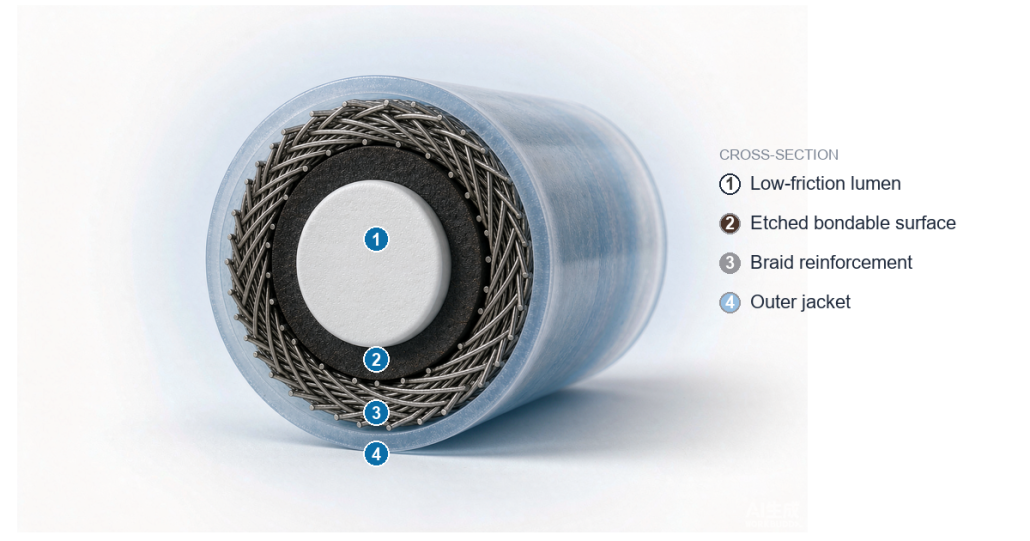
In many shafts the practical answer is an outer-surface-etched liner. The bore stays as it was, tuned for low-friction guidewire and device passage, while the outside is prepared to join the next layer of the shaft.
Important regulatory boundary. Medical grade does not mean a tube is automatically biocompatible, FDA-cleared, sterilization-qualified, or right for every finished device. Biological safety and performance are assessed for the complete final device in its intended clinical configuration.
What is etched PTFE tubing?
Etched PTFE tubing is polytetrafluoroethylene tubing that has received a surface treatment designed to overcome PTFE’s naturally low surface energy and non-stick behavior.
Standard PTFE makes a good catheter liner because it gives a smooth, low-friction pathway. The same surface, though, makes a reliable bond to polymers, adhesives, or metals difficult to achieve.
Chemical etching alters only the surface region of the PTFE. The aim is a more reactive, higher-energy surface that interacts more effectively with an adhesive, a primer, a tie layer, or a molten polymer jacket.
Sodium-based chemistry is the most common route. The treatment strips fluorine from the PTFE surface and leaves behind a carbon-rich layer with reactive sites for bonding.
The distinction between controlled medical stock and general-purpose tubing is worth understanding before a project starts. It is covered in more detail under medical-grade PTFE tubing.
Why is PTFE etched for medical catheters?
PTFE is naturally difficult to bond
Low friction and chemical resistance are exactly why PTFE gets chosen, and low surface energy is what delivers both. Low-surface-energy materials resist wetting, so adhesives and molten polymers struggle to spread across the surface and anchor to it.
Without surface treatment or a retention strategy, a liner can delaminate during reflow, bending, tensile loading, sterilization, or aging.
Etching creates a bondable interface
Sodium-based etching modifies the outermost PTFE surface. Fluorine leaves the surface, a carbon-rich and chemically active layer takes its place, and interaction with adhesives and polymer jackets improves.
In catheter manufacturing this can open the door to bonding between the PTFE liner and materials such as Pebax, nylon, TPU, PU, or a compatible adhesive system. The material combination, treatment condition, reflow profile, and device geometry still call for device-specific verification.
A single-side etch can preserve the low-friction lumen
A catheter liner usually carries two different jobs on its two surfaces. The bore exists for guidewire, balloon, stent, or device passage. The outside exists to bond to the jacket, braid, coil, adhesive, or tie layer. Treating only the surface that has to bond keeps the other one working as designed.
How is medical PTFE etched?
Sodium-based chemical etching
Sodium chemistry is the established method for improving PTFE liner bondability. A sodium reagent reacts with the PTFE surface and modifies the outermost molecular region, reducing its fluorinated character and creating sites that interact with whatever comes next.
Sodium-naphthalene and sodium-ammonia systems are the terms that turn up most often in supplier documentation. The exact chemistry, exposure time, rinsing, neutralization, drying, residual controls, and acceptance criteria are supplier process details, and they belong under a documented quality system.
Plasma treatment
Plasma treatment is a second surface-modification route. It can be evaluated where a project wants dry processing, a short time from treatment to assembly, or a specific process flow.
Plasma treatment and chemical etching are not automatically interchangeable. Compare them on bond strength after aging, process repeatability, treatment uniformity, storage sensitivity, equipment availability, geometry, and total manufacturing cost.
Mechanical roughening is not a direct substitute
Mechanical roughening can add surface texture, but it does not necessarily reproduce the chemical modification that a validated etching process creates. On thin-wall or microbore liners it also risks wall integrity, dimensions, and particulate control.
The chemistry behind the treatment, including how sodium-ammonia etching is applied in cardiovascular work, is set out in PTFE etching for medical devices.
Single-side vs. double-side etched PTFE
| Option | Best fit | Key advantage | Main caution |
|---|---|---|---|
| Unetched PTFE | No bonding requirement, or a mechanical-retention design | Retains the original PTFE surface | May not bond reliably to catheter layers |
| Outer-surface etched PTFE | Most multilayer catheter shaft constructions | Supports jacket or tie-layer bonding while keeping a low-friction inner lumen | Confirm that the required outer surface is consistently treated |
| Inner-surface etched PTFE | Special cases where the lumen needs a later coating or bond | Enables downstream lumen-side treatment | May change lumen-surface behavior; test it functionally |
| Double-side etched PTFE | Designs that need bonding or coating on both sides | Supports two functional interfaces | Adds process complexity; confirm the effect on lumen friction and contamination control |
Do not order “etched PTFE” and stop there. State whether the OD, the ID, or both surfaces need treatment, which material has to bond to the liner, and which bond test will define acceptance.
Can etched PTFE bond to Pebax, nylon, TPU, and PU?
Etched PTFE can be evaluated for bonding to common catheter-jacket materials such as Pebax, nylon, TPU, and PU. Real bond performance depends on the specific treatment, the polymer grade, the assembly process, device geometry, reflow conditions, and the validation method.
For a production-ready design, verify bonding after the initial catheter assembly, after worst-case reflow or thermal processing, after simulated clinical bending and device passage, after the intended sterilization, after accelerated and real-time aging as applicable, and after shipping or packaging simulation where relevant.
The wrong question is whether material A bonds to etched PTFE. The useful question is whether this complete catheter construction still holds the required bond strength and lumen function after manufacturing, sterilization, aging, and simulated use.
- Initial catheter assembly
- Worst-case reflow or thermal processing
- Simulated clinical bending and device passage
- Intended sterilization
- Accelerated and real-time aging, as applicable
- Shipping and packaging simulation where relevant
The trade-offs between liner and jacket materials are compared in PTFE vs FEP vs Pebax tubing for medical devices.
Need an Etched PTFE Liner for a Catheter Project?
Share your catheter application, ID, OD, wall thickness, etch location, mating polymer, assembly process, sterilization method, and annual-volume target. Our team can help evaluate a custom etched PTFE liner configuration.
Does etched PTFE affect lumen friction?
Etching can be limited to a single surface. In a typical outer-surface-etched design the lumen-facing surface stays untreated, so the PTFE surface responsible for low-friction device movement is preserved.
If the ID is etched, or if double-sided treatment is chosen, measure functional performance instead of assuming it holds. Relevant tests include guidewire insertion and withdrawal force, balloon or device passage force, lubricity under bending, lumen patency, particulate generation, and post-aging performance.
This matters most in neurovascular, coronary, microcatheter, and small-diameter delivery systems, where a small shift in friction or in effective lumen geometry can change how the device performs.
Storage and shelf life of etched PTFE
Etched PTFE is a controlled surface. It is not standard PTFE tubing with a permanent, generic property.
Storage conditions, packaging integrity, light exposure, handling, and elapsed time all influence the condition of the treated surface. Sodium-etched PTFE can be sensitive to UV exposure, so sealed, light-protective packaging and controlled storage help limit any loss of bondability.
Treat our own etched PTFE liner storage guidance as a project starting point rather than a universal shelf-life claim. The controlled supplier documentation for the actual lot and treatment method governs.
- Supplier name, lot number, and material grade
- PTFE tubing dimensions and tolerance
- Etch configuration: OD, ID, or both
- Etching method or controlled process identification
- Date of treatment, packaging date, and expiration or use-by date
- Storage conditions and light-protection requirements
- Certificate of Analysis and Certificate of Conformance requirements
- Incoming visual and dimensional inspection criteria
- Bondability verification method, if required
Can etched PTFE be sterilized?
Etched PTFE may be evaluated for devices sterilized by EtO, gamma, e-beam, steam, or another validated method. Material-level compatibility is not a substitute for final-device verification.
The complete device has to be tested after the intended sterilization cycle. That includes the liner, the modified surface, adhesives, tie layers, the outer jacket, reinforcement, markers, coatings, residuals, packaging, and the specific sterilization dose or cycle.
FDA frames biological evaluation under ISO 10993-1 as a risk-management process for medical devices. The evaluation looks at the final device, its materials, its manufacturing, the type of body contact, and how long that contact lasts.
What does medical grade mean for etched PTFE?
Medical grade is not a single universal regulatory classification. On a device project it is most useful when it refers to controlled material and process documentation that supports the finished device’s development and quality requirements.
| Documentation or control | Why it matters |
|---|---|
| Lot traceability | Supports investigation, change control, and supplier qualification |
| Certificate of Analysis or Conformance | Confirms specified dimensions, material identity, or defined test results |
| Etching configuration control | Confirms whether the OD, the ID, or both surfaces were treated |
| Packaging and storage specification | Helps preserve surface condition and defines handling controls |
| Shelf-life or use-by control | Helps manage surface-treatment aging risk |
| Change notification process | Helps protect validated manufacturing and regulatory documentation |
| Cleanliness and packaging requirements | Supports catheter assembly and contamination-control needs |
| Material and processing disclosure | Supports risk-based biological evaluation and chemical-characterization planning |
A material document can support a biological evaluation. It does not replace the evaluation of the finished device. FDA’s biocompatibility framework expects manufacturers to weigh device materials, manufacturing processes, clinical use, and exposure conditions together.
What should be in an etched PTFE RFQ?
- Application: guide catheter, microcatheter, introducer sheath, balloon catheter, delivery system, or other device
- Target geometry: ID, OD, wall thickness, length, taper, and tolerance
- Surface requirement: unetched, OD etched, ID etched, or double-side etched
- Mating layer: Pebax, nylon, TPU, PU, adhesive, tie layer, metal, or another material
- Assembly process: reflow, overjacket, adhesive bonding, thermal bonding, overmolding, or mechanical capture
- Performance priorities: low friction, high bond strength, ultra-thin wall, flexibility, torque, kink resistance, burst performance, or device passage
- Sterilization method and expected shelf-life target
- Packaging, cleanliness, labeling, lot-traceability, and documentation requirements
- Development quantity, validation quantity, and expected annual commercial volume
- Requested quality agreements, change-control requirements, and incoming inspection documentation
Common failure modes
Delamination
Look first at insufficient treatment, aged etched surfaces, surface contamination, the wrong mating polymer, poor reflow conditions, an unsuitable adhesive, or high interface stress during bending.
Wrinkling or buckling
Thin liners wrinkle when the shaft is reflowed, compressed, bent, or assembled under uneven radial pressure. Evaluate the liner as part of the full shaft construction, not on its own.
Reduced bond consistency
A treated surface drifts with storage, UV exposure, handling, lot variation, and assembly conditions. Define a controlled window that runs from package opening to final assembly.
Poor lumen performance
A liner can bond perfectly and still deliver a poor lumen: ovality, local compression, folds, particulate, or an ID that is too small once the shaft is built. Use device-passage testing, not dimensional inspection alone.
Frequently asked questions
What is the difference between etched and unetched PTFE?
Unetched PTFE retains its original low-surface-energy, low-friction surface. Etched PTFE has a modified surface designed to improve bonding to adhesives, polymers, or other catheter layers.
Why is PTFE liner etched on the outside?
The outer surface is often etched because it has to bond to an outer jacket, tie layer, braid, coil, or adhesive. Leaving the inner surface unetched preserves the low-friction lumen used for guidewire and device passage.
Can etched PTFE bond directly to Pebax?
It can be evaluated for direct thermal bonding or bonding through a compatible process. Confirm performance with the exact Pebax grade, liner geometry, reflow conditions, sterilization method, and post-aging test plan.
Is double-side etched PTFE always better?
No. Double-side etching is useful only when both surfaces need a bonding or coating function. If the lumen does not need treatment, outer-surface etching may better preserve the intended low-friction lumen interface.
How long can etched PTFE be stored?
Use the supplier’s controlled shelf-life specification for the applicable product and lot. Storage conditions, packaging, UV exposure, and handling can all affect treated-surface performance.
Is etched PTFE automatically biocompatible?
No. Biocompatibility is assessed for the final finished medical device in its intended use. The assessment considers the complete material system, manufacturing processes, clinical exposure, and risk-management evidence.
Conclusion
Use etched PTFE tubing when a catheter needs both a low-friction PTFE lumen and a reliable bondable surface for multilayer construction.
On most catheter liner projects, start by evaluating an outer-surface-etched PTFE liner, define the mating layer and the assembly process, protect the treated surface through controlled packaging and storage, and validate the finished device after sterilization and aging.
The best etched PTFE specification is not simply medical grade or double-side etched. It is a controlled combination of geometry, etch location, treatment quality, storage window, bonding process, verification method, and final-device risk assessment.
Request a Custom Etched PTFE Tubing Quote
Send your tubing drawing, target dimensions, required etch surface, mating material, reflow or bonding process, documentation requirements, and forecast volume for a project-specific review.
Sources
- Biocompatibility Assessment Resource Center. U.S. Food and Drug Administration. Risk-based biocompatibility assessment for medical devices.
- Use of International Standard ISO 10993-1, Biological Evaluation of Medical Devices, Part 1. U.S. Food and Drug Administration. Biological evaluation within a risk management process.
- Solving PTFE Liner Bonding Challenges in Catheters. Hydromer. Etched PTFE liner bonding context for catheter construction.
- Etching Process of PTFE and the Preservation and Use of PTFE Etching Tube. MedicalPTFE. Etching process and preservation notes.
- How to Drive Performance and Yield in Catheter Development with Etched PTFE Liners. Chamfr. Etched PTFE liner performance and yield considerations.
This article is educational. It does not replace device-specific design verification, validation, risk management, or regulatory assessment, and it does not establish that PTFE, etched PTFE, medical grade, a Certificate of Analysis, ISO 10993 data, or sterilization compatibility alone makes a finished device biocompatible, FDA-cleared, approved, compliant, sterile, or safe.