Medical-Grade FEP Heat Shrink Tubing for Catheter Reflow: Selection, Process, and Validation Guide
Direct answer
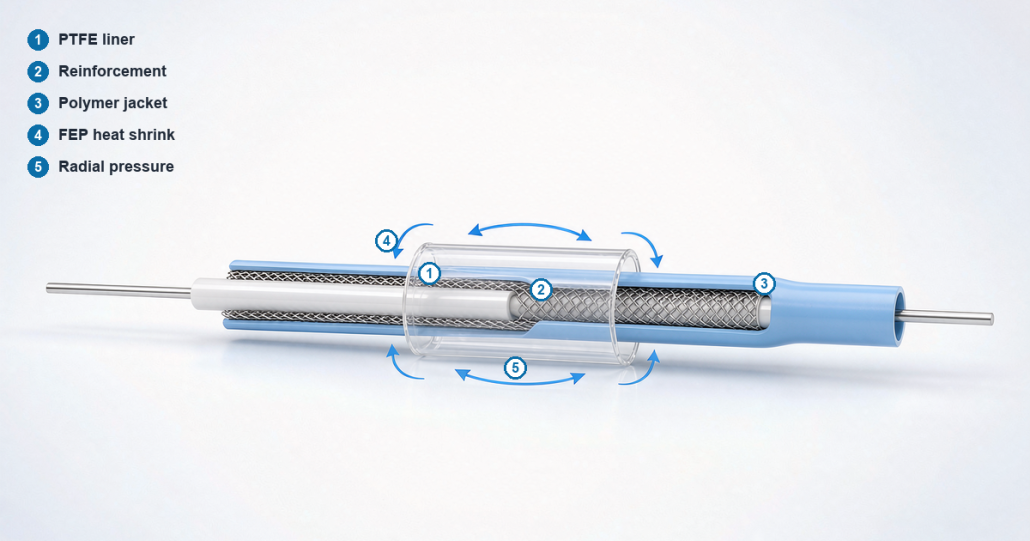
Medical-grade FEP heat shrink tubing usually works as a temporary process sleeve in catheter reflow, shaft fusion, joint bonding, insulation, and component protection. Heat makes the sleeve contract around a catheter subassembly and press inward evenly, which helps the outer polymer layers conform around a PTFE liner, a braid, a coil, a marker band, or other internal parts.
For many catheter processes, a 1.6:1 FEP heat shrink ratio is a reasonable place to start. Medical FEP heat shrink products may list full recovery at around 210 degrees Celsius, or 410 degrees Fahrenheit, but the process window that actually matters is the one validated on your complete catheter construction and your real heating method.
Select the sleeve against the whole process, not the shrink ratio alone: maximum assembly OD, target recovered diameter, wall thickness, heat source, reflow temperature, dwell time, required radial compression, stripping method, catheter-jacket material, and allowable longitudinal change.
Important. When FEP heat shrink is stripped after reflow, it is normally a manufacturing aid rather than a patient-contact component. If it stays in the finished device, it has to be evaluated as part of the device material system, the manufacturing process, the sterilization method, and a risk-based biological evaluation.
What is medical-grade FEP heat shrink tubing?
FEP heat shrink tubing is expanded fluorinated ethylene propylene tubing that contracts under heat. In medical-device manufacturing, it is widely used to apply external pressure during the thermal assembly of catheter shafts and joints.
What separates it from ordinary FEP tubing is that it carries a defined expanded size, recovered size, shrink ratio, recovery temperature, wall thickness, and longitudinal-change behavior. Those numbers decide whether a sleeve can slip over a subassembly, deliver the right compression while hot, and come off again without marking the catheter surface.
The product family is described in more detail under FEP heat shrink tubing. Typical jobs for the medical grades include:
- Catheter shaft reflow
- PTFE liner, braid, and polymer-jacket fusion
- Coil-reinforced catheter assembly
- Catheter joint bonding
- Distal-tip forming
- Electrical insulation in medical instruments
- Temporary protection of sensitive device components
Why use FEP heat shrink for catheter reflow?
It applies uniform radial pressure
During reflow, the outer jacket softens and flows around whatever sits beneath it. FEP heat shrink contracts around the full circumference, so the compression is far more even than a localized clamp or a hand-wrapped method can produce.
That pressure helps the jacket conform around braids, coils, transitions, and marker regions, and it improves the continuity of the outer surface.
It helps build multilayer shafts
A typical catheter shaft stacks a PTFE inner liner, a braid or coil reinforcement layer, and one or more polymer-jacket segments. FEP heat shrink holds the stack together while heat drives the intended thermal assembly.
MedicalPTFE describes FEP heat shrink as a way to fuse multiple layers in catheter structures built from polyurethane, Pebax, and polyamide. The approach is covered in medical-grade FEP heat shrink tubing in multi-layer catheters.
It can provide visual process control
Clear FEP heat shrink lets an operator watch layer movement, jacket flow, braid position, marker bands, and defects during assembly. That visibility pays off most during process development and troubleshooting.
It is designed for high-temperature processing
FEP heat shrink is commonly associated with full-recovery temperatures around 210 degrees Celsius. That thermal resistance makes it usable in catheter processes that would defeat many general-purpose heat-shrink materials.
TE lists a 210 degrees Celsius minimum full-recovery temperature for a medical FEP 1.6:1 product. Zeus lists FEP Lay-Flat heat shrink at a nominal recovery temperature around 205 degrees Celsius, with ratios up to 1.6:1.
Key specifications
| Parameter | What it means | Why it matters in catheter reflow |
|---|---|---|
| Expanded ID | Inner diameter before heating | Must fit over the maximum catheter subassembly OD |
| Recovered ID | Approximate inner diameter after full shrink | Must apply enough compression without over-constraining the shaft |
| Shrink ratio | Relationship between expanded and recovered diameter | Defines how much geometry variation the sleeve can take up |
| Wall thickness | Tube wall before and, where specified, after recovery | Affects handling, heat transfer, radial compression, and stripping behavior |
| Recovery temperature | Temperature at which full or near-full recovery occurs | Must sit inside the thermal window of the catheter polymer and adhesive |
| Longitudinal change | Length change during recovery | Affects component placement, yield, and dimensional repeatability |
| Transparency | Visual clarity of the tubing | Helps observe braid, coil, marker, and polymer flow during process development |
| Surface finish | Inner-surface behavior during reflow and removal | Affects stripping force and the risk of marking the outer jacket |
| Material documentation | CoA, CoC, lot traceability, change control | Supports supplier qualification and manufacturing consistency |
What does a 1.6:1 shrink ratio mean?
A 1.6:1 shrink ratio means the expanded diameter of the tubing can come down by roughly a factor of 1.6 under the supplier’s stated recovery conditions.
As a planning example, a nominal expanded ID of 1.60 mm may recover toward approximately 1.00 mm. Treat that as a rough starting figure, not a replacement for the supplier’s dimensional drawing, recovered-ID tolerance, actual wall thickness, and production-lot test data.
Approximate recovered ID
Approximate recovered ID = Expanded ID ÷ Shrink ratio
Example for 1.6:1 tubing
1.60 mm ÷ 1.6 ≈ 1.00 mm
Four conditions decide whether a given size works in practice:
- The sleeve has to slide over the largest feature of the catheter assembly before heating.
- The sleeve has to recover enough to press on the smallest shaft region that matters.
- The sleeve must not compress so hard that it imprints braid, deforms a soft jacket, constricts the lumen, or leaves surface defects.
- The sleeve has to remain removable once the reflow cycle ends.
Product families, ratio options, and manufacturer details are set out under FEP heat shrink tubing medical grade.
How to choose FEP heat shrink size
Step 1: Measure maximum assembly OD
Find the largest OD the FEP sleeve must pass over before it is heated. That is not only the nominal shaft OD. Marker bands, braid overlaps, coil transitions, distal-tip features, proximal joints, and ordinary manufacturing variation all count.
Step 2: Identify the smallest region that needs compression
Find the shaft region where the sleeve still has to generate useful compression after it shrinks. If the recovered FEP ID stays too large there, radial pressure may not be enough for a consistent reflow.
Step 3: Choose a ratio with process margin
Pick a ratio that covers both the maximum pass-over geometry and the smallest region that needs compression. A higher ratio is not automatically better. On stepped, tapered, or thin-wall assemblies it can sharpen compression sensitivity and make the process harder to hold.
Step 4: Select wall thickness based on the process
Thin-wall FEP heat shrink conforms more easily and responds faster to heat. Thicker walls resist handling damage better and behave differently under pressure. Catheter geometry, heating method, stripping process, and outer-jacket material decide which trade-off wins.
Step 5: Confirm longitudinal change
Longitudinal change can shift a sleeve during heating or change the tension around tapered and stepped sections. Where the catheter assembly is tightly controlled, write a longitudinal-change requirement into the specification and verify it on incoming lots.
TE reports longitudinal-change control as low as plus or minus 2 percent on selected medical FEP heat shrink constructions. Treat that as product-specific rather than a universal FEP value.
How to use FEP heat shrink in catheter reflow
- Assemble the PTFE liner, reinforcement layer, marker bands, polymer jackets, and mandrel according to the shaft build.
- Select an FEP heat shrink sleeve that passes over the maximum assembly OD with suitable clearance.
- Position the sleeve over the intended reflow zone without introducing wrinkles, twist, or tensile preload.
- Apply the validated heat profile using a controlled heat source, such as a convection oven, a hot-air system, or another validated process.
- Let the polymer jacket reflow while the FEP sleeve applies uniform external compression.
- Cool the assembly according to the validated process.
- Strip, or slit and remove, the FEP sleeve if it is a temporary process aid.
- Inspect the shaft for surface finish, OD, concentricity, braid imprint, lumen patency, bond integrity, and other device-specific criteria.
Process note. A 210 degrees Celsius FEP recovery temperature does not mean every catheter should be processed at 210 degrees Celsius. The final heat profile depends on the polymer jacket, the adhesives, the markers, the reinforcement, the mandrel, and how much thermal exposure the assembly can take.
Need FEP Heat Shrink for a Catheter Reflow Process?
Share your maximum assembly OD, target recovered size, shrink ratio, wall thickness, reflow temperature, catheter materials, sleeve length, stripping method, documentation requirements, and annual volume. Our team can help evaluate a custom FEP heat shrink tubing configuration.
Why does FEP heat shrink wrinkle or create surface defects?
Wrinkling, bubbles, uneven recovery, or a poor catheter surface usually trace back to the process system rather than to the tubing on its own.
| Symptom | Possible causes | What to investigate |
|---|---|---|
| FEP sleeve wrinkles | Oversized sleeve, uneven heating, poor positioning, geometry transition | Sleeve ID, heat profile, fixture alignment, taper transition |
| Braid imprint | Excessive radial compression, thin outer jacket, insufficient polymer flow | Sleeve ratio, wall, jacket thickness, dwell time |
| Uneven OD | Nonuniform heating, inconsistent jacket thickness, sleeve movement | Oven or hot-air uniformity, component centering, longitudinal change |
| Lumen constriction | Excessive reflow pressure, liner deformation, incompatible thermal profile | Recovered ID, mandrel support, liner wall, process temperature |
| Difficult stripping | Surface interaction, over-reflow, insufficient cooling, sleeve wall selection | Removal temperature, cooling step, sleeve grade, stripping technique |
| Layer delamination | Incompatible materials, inadequate liner treatment, insufficient thermal bonding | Etched liner condition, tie layer, jacket material, reflow profile |
| Surface bubbles | Entrapped air, moisture, contamination, rapid heating | Material conditioning, assembly cleanliness, ramp rate |
That is why FEP heat shrink should be qualified together with the full catheter shaft, not as a standalone consumable.
Can FEP heat shrink be left on the final device?
FEP heat shrink can serve as a retained insulating, protective, or structural layer in some devices. That is a different situation from using it as a temporary reflow sleeve.
Where the material pairing needs closer study, the liner and jacket options are compared in PTFE vs FEP vs Pebax tubing for medical devices.
If FEP heat shrink stays on the finished device, evaluate it as part of the complete device material system and the finished-device biological evaluation. The questions that drive that evaluation include:
- Intended body contact type and duration
- Sterilization compatibility
- Colorants, radiopaque additives, inks, and other non-base-resin constituents
- Manufacturing residues and potential extractables
- Mechanical durability, abrasion, cracking, and edge condition
- Adhesion or migration at interfaces
- Final-device biological evaluation requirements
- Packaging and shelf-life effects
What does medical grade mean for FEP heat shrink?
Medical grade is not a claim that a material is automatically approved, biocompatible, sterile, or right for every medical device.
On an FEP heat shrink purchase, medical-grade suitability is defined by the controls and documentation the project actually requires.
| Requirement | Why it matters |
|---|---|
| Lot traceability | Supports incoming inspection, investigation, and complaint handling |
| CoA / CoC | Documents agreed material identity, dimensions, or test results |
| Dimensional specification | Defines expanded ID, recovered ID, wall thickness, and tolerances |
| Shrink-performance data | Confirms ratio, recovery condition, and longitudinal change |
| Packaging specification | Protects tubing from contamination, deformation, and handling damage |
| Change notification | Helps protect validated manufacturing processes |
| Cleanliness requirements | Supports process controls for catheter assembly |
| Material disclosure | Supports risk-based final-device evaluation when the tubing is retained |
| Sterilization compatibility data | Useful only when relevant to the actual final-device configuration |
What should be in an FEP heat shrink RFQ?
Use this checklist when requesting FEP heat shrink tubing for a medical-device or catheter manufacturing project. Where a dimension is still open, our medical tubing size guide is a useful starting reference.
- Intended use: temporary reflow sleeve, final protective layer, insulation, or retained device component.
- Expanded ID, target recovered ID, and required shrink ratio.
- Pre-shrink and recovered wall thickness.
- Sleeve length, cut length, spool format, or continuous length.
- Target catheter or component maximum OD and minimum OD.
- Straight, tapered, stepped, slit, flared, or pre-cut geometry.
- Clear, colored, radiopaque, or custom visual requirement.
- Required longitudinal-change range.
- Reflow temperature range, heat source, and estimated dwell time.
- Expected stripping method and any surface-finish restrictions.
- Sterilization method if the tubing remains in the final device.
- Cleanliness, packaging, lot traceability, CoA, CoC, and change-control requirements.
- Prototype, validation, and annual production quantities.
Frequently asked questions
What is medical-grade FEP heat shrink tubing used for?
Medical-grade FEP heat shrink tubing is commonly used for catheter reflow, shaft fusion, joint bonding, insulation, and temporary component protection. In catheter manufacturing, it often acts as a temporary sleeve that applies uniform radial pressure during heating.
What does 1.6:1 FEP heat shrink mean?
A 1.6:1 ratio means the tubing can reduce from its expanded diameter toward an approximate recovered diameter that is about one divided by 1.6 of the original expanded size, subject to the supplier’s stated recovery conditions and tolerances.
What temperature does FEP heat shrink require?
Many medical FEP heat shrink products list full recovery around 210 degrees Celsius or 410 degrees Fahrenheit. The actual catheter process temperature must be validated for the complete assembly and may differ based on heating method and catheter materials.
Can FEP heat shrink be used with PTFE liners and Pebax jackets?
Yes. FEP heat shrink is commonly used as an external process sleeve to assist reflow of multilayer catheter constructions that may include PTFE liners, reinforcement layers, and Pebax or other polymer jackets. The process should be confirmed for the specific material stack-up.
Is FEP heat shrink a permanent catheter component?
Often no. It is frequently used as a temporary reflow process aid and removed after the catheter shaft cools. If it remains on the final device, it should be evaluated as part of the finished device.
Why is my FEP heat shrink difficult to remove?
Possible reasons include sleeve size selection, wall thickness, cooling conditions, outer-jacket interaction, excessive reflow, stripping technique, or local geometry changes. Evaluate removal using the actual material stack-up and validated process window.
Can FEP heat shrink be sterilized?
FEP heat shrink may be evaluated for compatibility with a target sterilization method, but the relevant assessment is for the full finished device, including all materials, processing, packaging, and intended use.
Conclusion
Use medical-grade FEP heat shrink tubing when the catheter process needs controlled, uniform radial compression during reflow, layer fusion, or joint formation.
On a typical multilayer catheter, start with the maximum assembly OD, the smallest zone that requires compression, a workable shrink ratio such as 1.6:1, the required wall thickness, and the thermal limits of the complete construction.
Then confirm the process through real trials that measure OD consistency, surface finish, braid imprint, lumen patency, bond integrity, and stripping behavior.
The right FEP heat shrink tubing is not the one with the highest shrink ratio. It is the tubing that keeps the catheter process stable and repeatable without compromising shaft dimensions, lumen function, or final-device performance.
Request a Medical FEP Heat Shrink Quote
Send your drawing, desired expanded and recovered ID, wall thickness, shrink ratio, cut length, color or transparency requirement, packaging specification, documentation needs, and volume forecast for a project-specific quote.
Sources
- MT FEP Heat Shrink Tube: Single Wall. TE Connectivity. Product information for medical FEP heat shrink tubing, including up to 1.6:1 shrink ratio, a 210°C minimum full-recovery temperature, and controlled longitudinal change.
- FEP Medical Grade Heat Shrink Tubing. TE Connectivity. Overview of medical-device applications for FEP heat shrink tubing, including protection and insulation.
- Heat Shrink Comparison & Recovery Guide. Zeus. FEP heat-shrink recovery and shrink-ratio context, including nominal 205°C recovery conditions and up to 1.6:1 ratio.
- Medical Grade FEP Heat Shrink Tubing in Multi-Layer Catheters. MedicalPTFE. Describes FEP heat shrink use in multilayer catheter structures and fusion of polymer layers.
- Recognized Consensus Standards: Medical Devices. U.S. Food and Drug Administration. FDA-recognized consensus-standard listing for ISO 10993-1 biological evaluation requirements and principles.
- ISO 10993-1:2018 – Biological Evaluation of Medical Devices. International Organization for Standardization. General principles for identifying, assessing, and managing biological risks associated with medical devices.
This article is educational. It does not replace device-specific design verification, process validation, sterilization validation, biological evaluation, risk management, or regulatory assessment, and it does not establish that medical-grade FEP heat shrink tubing is automatically biocompatible, FDA-cleared, FDA-approved, sterilization-qualified, implantable, USP Class VI compliant, or ISO 10993 compliant.