Flanging & Flaring PTFE/FEP Pipe: Seal Without Threads
You cannot thread PTFE pipe the way you thread steel. Cut a thread into fluoropolymer and the first torque either strips it or cold-flows it into a leak. So fluoropolymer lines are joined the thread-free way: a flange or a flare.
Direct answer: Flanging forms a flat rim on the pipe end that seats against a matching flange with a gasket and bolts. Flaring opens the end into a cone (commonly 37° or 45°) that seals into a matching fitting. Both need heat or special tooling on PTFE/FEP because the materials creep and “remember” their shape — PTFE is formed hot around 260–280 °C (500–536 °F) and locked by cooling, while FEP melts near 270 °C (518 °F) and heat-forms in one piece more easily.
Flange vs flare — what is the difference?
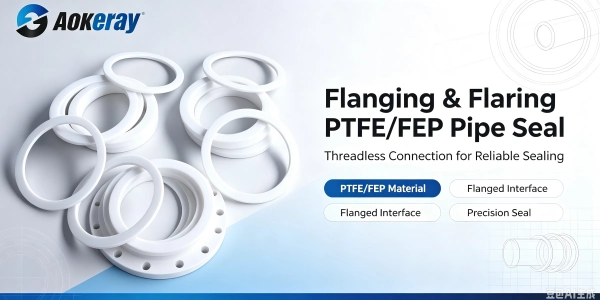
A flange is a disc rim at the pipe end. Two flanges face each other, a gasket sits between, and bolts pull them together. It is the standard for larger lines, tank nozzles, and anything you need to take apart. A flare is the pipe end opened into a cone that wedges into a matching fitting and seals on the cone face — common on smaller instrument and_sample lines where you want a compact, fixed joint.
Pick a flange when the joint is large or must be opened often. Pick a flare when the line is small and the fitting is already a flare type.
Why PTFE and FEP need special handling
Two properties make fluoropolymers behave differently from metal or even PVC:
- Cold flow (creep). Under sustained load PTFE deforms slowly. Bolt it too hard and it creeps; the gasket load drops and the joint weeps days later.
- Thermal memory. Heat PTFE into its forming range and it stays where you shape it — if you cool it under pressure. Let it cool free and it relaxes back.
- Very low friction (CoF ~0.04). Good for the fluid, awkward for a joint that must not slip.
FEP is easier to form in one piece because it melt-processes; PTFE is formed by heating into a gel-like state and tooling it. Either way, the shape is set by heat plus hold, not by cutting.
Four ways to flange or flare fluoropolymer pipe
| Method | How it works | When to use |
|---|---|---|
| Solid machined flange | A flange is machined from solid PTFE and butt- or overlay-welded to the pipe | Pure fluoropolymer joint, full chemical resistance |
| Loose flange + stub end | A plain (often steel or PTFE) loose flange rides on a formed PTFE stub end | Most common; flange is reusable, stub takes the chemical |
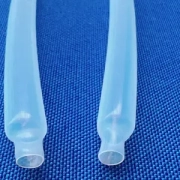
| Heat-formed field flare | The pipe end is heated and flared into a cone with a forming tool | Small lines, site flare into a flare fitting |
| Cold flare (rare) | Formed without heat | Only for thin-wall, low-demand parts; PTFE usually needs heat |
Standards and sizes that matter
Flanges follow the same face standards as metal: ANSI B16.5, DIN/EN 1092, and JIS 10K are the common ones, so a fluoropolymer flange mates with a steel one already in the line. Sizes run from about 1/2″ up to 24″ (13–600 mm) and beyond. Pipe and resin are covered by ASTM D4894/D4895 (PTFE) and ASTM F1545 (fluoropolymer piping). Food- and pharma-grade lines use virgin resin meeting FDA 21 CFR 177.1550 and USP Class VI.
Where flanged or flared fluoropolymer lines show up
- Chemical process lines — acid, solvent, and oxidizer transfer where metal would corrode.
- Pharma and food — virgin-grade lines for API/solvent and sanitary transfer.
- Tank nozzles and dip pipes — a flanged nozzle into a lined vessel.
- Instrument and sample lines — small flared ends into analyzers.
Mistakes that turn a good joint into a weep
Threading the pipe
It does not hold. Fluoropolymer threads strip or creep; use a flange or flare.
Over-torquing the flange bolts
This is the one we see most. Hard bolting cold-flows the PTFE, load drops, and it leaks after a heat cycle. Torque to a value that leaves creep room, then re-torque after the line has run hot once.
Forming cold
A cold-formed PTFE end relaxes. Heat it into the forming range and cool it under hold, or the flange springs back.
Mismatching the flange standard
ANSI, DIN, and JIS faces and bolt circles differ. Confirm the standard before you form, or the flange will not mate.
Forgetting permeation
PTFE is near-impermeable to most liquids but some small molecules permeate slowly. For a contained toxic or volatile stream, plan a weep/vent path rather than assuming zero passage.
How to spec a flanged or flared PTFE/FEP joint
- Joint type — flange (and standard: ANSI/DIN/JIS) or flare (37°/45°).
- Pipe size and schedule (wall).
- Forming method — solid flange, loose flange + stub, or field flare.
- Service temperature and chemical; virgin vs filled grade.
- Compliance — FDA/USP for food/pharma, RoHS/REACH for industrial.
Frequently asked questions
How do you flange PTFE pipe?
You form a flange by heating the PTFE end into its forming range (around 260–280 °C / 500–536 °F) and tooling it against the flange face, then cooling under light pressure so the shape locks. The common field method is a loose flange riding on a formed PTFE stub end.
Can FEP tube be flared?
Yes. FEP melt-processes near 270 °C (518 °F), so it heat-forms and flares in one piece more easily than PTFE. Use it for lower-temperature lines (about 200 °C / 392 °F continuous).
Flange or threaded connection for PTFE?
Flange (or flare). PTFE cannot be reliably threaded — it strips or cold-flows. A flange with a gasket and bolts is the standard thread-free seal.
Why does my PTFE flange leak after a heat cycle?
Cold flow. Over-tight bolts creep, gasket load falls, and the joint weeps once it warms. Torque to leave creep room and re-torque after the first heat cycle.
What flange standards apply to PTFE pipe?
The same as metal: ANSI B16.5, DIN/EN 1092, and JIS 10K, so a fluoropolymer flange mates with existing steel flanges. Sizes run from about 1/2″ to 24″ and larger.
Is flanged PTFE pipe food- or pharma-grade?
Virgin-grade PTFE meeting FDA 21 CFR 177.1550 and USP Class VI is used for food and pharma lines. Confirm the resin certification for the specific lot.