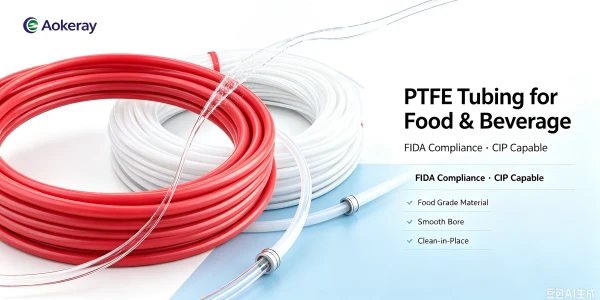
PTFE Tubing for Food & Beverage: FDA & CIP Explained
A food line lives or dies on what the fluid touches. If the tube reacts with the product, holds taste, or traps residue in its bore, no amount of downstream cleaning fixes it. PTFE is the quiet default for the lines where that matters.
Direct answer: PTFE (Teflon) tubing is a sanitary, chemically inert fluid path for food and beverage transfer. Virgin PTFE complies with FDA 21 CFR 177.1550 for repeated food contact, tolerates CIP and SIP steam cleaning, and transfers no taste, odor, or color. Use the virgin (unfilled) grade for compliance; glass- or bronze-filled PTFE needs separate migration data and is not automatically food-grade.
Is PTFE tubing FDA approved for food?
The precise wording matters. The FDA does not “approve” a material the way it approves a drug. It sets a regulation, and a material complies with it. For fluoropolymers that regulation is 21 CFR 177.1550 — “Perfluorocarbon resins” — which covers PTFE, FEP, and PFA for repeated food contact across all food types and use conditions A through H (hot-fill, retort, freezer-to-oven).
The regulation also sets extraction limits so the tube cannot leach into food: total extractables no more than 3.1 mg/dm² (0.2 mg/sq in), and fluoride (as F) no more than 0.46 mg/dm² (0.03 mg/sq in). A food-grade PTFE tube is one whose virgin resin and finished part stay inside those numbers.
Why PTFE over silicone, PVC, or PU
| Property | PTFE | Silicone | PVC / PU |
|---|---|---|---|
| Chemical inertness | Near-universal | Good, swells in oils/solvents | Limited; attacked by fats/solvents |
| Non-stick (CoF) | ~0.04, lowest of any solid | Higher | Higher |
| Temp range | −200 to 260 °C | Lower; softens with heat | Limited |
| Taste / odor transfer | None | Low, but possible | Possible |
| CIP / SIP steam | Yes, repeated | Yes, but ages faster | Often not rated |
| Best at | Oils, solvents, high heat | Flexible, clear, general | Low-cost, room-temp |
Silicone is the fair fight: it is flexible and clear and widely used. PTFE wins where the fluid is oily, solvent-based, or hot, or where any taste carryover is unacceptable. PVC and PU are the budget options and simply do not survive the chemistries PTFE shrugs off.
Can PTFE tubing be steam cleaned?
Yes. PTFE tolerates clean-in-place and steam-in-place without degrading. Typical CIP uses dilute caustic (about 1–3% NaOH) and acid (about 0.5–1.5% HNO₃); SIP runs steam at 121–150 °C (250–302 °F). Its smooth, non-porous bore resists residue and biofilm, so the line drains and cleans instead of harboring product.
Where food and beverage lines use PTFE
- Transfer lines for milk, juice, beer, wine, spirits, edible oil, syrups, and sauces.
- Filling and bottling machines — pump shafts, tri-clamp gaskets, dosing paths.
- Non-stick conveyor and release sheets — bake oven liners, stripper belts.
- Protective sleeves and heat-traced hose for viscous or temperature-sensitive product.
Standards and certifications
- FDA 21 CFR 177.1550 — the primary food-contact regulation for fluoropolymers.
- NSF/ANSI 51 — food equipment materials.
- 3-A Sanitary — a design standard (surface finish Ra ≤ 0.8 µm / 32 µin, drainability); PTFE meets it when the geometry complies. It is often used where 3-A is not mandated.
- EU 10/2011 and Reg. 1935/2004 — EU food-contact framework.
- RoHS / REACH — environmental compliance.
Mistakes that sink a food-grade spec
Assuming any PTFE is food-grade
Only virgin, unfilled PTFE is inherently 177.1550-compliant. Glass-, carbon-, or bronze-filled PTFE machines and wears better but changes the migration picture — it is not automatically food-grade. If the line touches food, specify virgin.
Forgetting extraction evidence
Compliance is shown with a Certificate of Compliance and extractable data, not a label that says “PTFE.” Ask for the numbers.
Running above the temperature limit
PTFE is stable to about 260 °C (500 °F). Push past that and it begins to decompose, with the familiar “PTFE flu” fume risk. Keep food processing within the rated range.
Assuming PFOA is in the tube
PFOA is a legacy processing aid, not a component of finished virgin PTFE at retail. If a customer asks, confirm “PFOA-free” per the supplier’s statement rather than guessing.
How to spec food-grade PTFE tubing
- Virgin (unfilled) PTFE grade; confirm 21 CFR 177.1550.
- Inner diameter, wall, and any tri-clamp or flange end.
- Service temperature and cleaning method (CIP/SIP).
- Surface finish if 3-A applies.
- Documentation: CoC plus extractable data on file.
Frequently asked questions
Is PTFE tubing FDA approved for food and beverage?
The FDA does not approve materials; it regulates them. Virgin PTFE complies with 21 CFR 177.1550 for repeated food contact, with extractable limits of 3.1 mg/dm² total and 0.46 mg/dm² fluoride. Ask for the supplier’s CoC and extraction data.
PTFE vs silicone tubing for beverage lines?
Silicone is flexible and clear and fine for many lines. PTFE wins for oily, solvent-based, or hot products and where zero taste transfer is required. For edible oil or spirit transfer, PTFE is the safer choice.
Can PTFE tubing be steam cleaned?
Yes. It tolerates CIP (dilute caustic and acid) and SIP steam at 121–150 °C without degrading, and its smooth bore resists residue and biofilm.
Does PTFE tubing transfer taste or odor?
No measurable taste, odor, or color transfer. That is why it is used for spirits, flavors, and anything where carryover would spoil a batch.
Is PTFE safe at high temperature?
Stable to about 260 °C (500 °F) continuous. Above that it decomposes and can release fume, so keep food processing within the rated range.
How do I verify food-grade compliance?
Request a Certificate of Compliance referencing 21 CFR 177.1550 and the extractable test results, plus confirmation the resin is virgin and PFOA-free per the supplier’s statement.