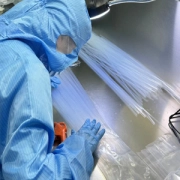
PTFE Tubing in Minimally Invasive Surgery: 6 Applications
Minimally invasive procedures depend on long, thin, flexible pathways that route devices, fluids, and energy through the body without open surgery. The material inside most of those pathways is PTFE — often as a sub-0.005 in (0.127 mm) liner you will never see.
Direct answer: PTFE tubing is used in cardiovascular and neurovascular catheters, drug-delivery and infusion systems, electrophysiology and structural-heart devices, surgical robotics, and GI endoscopy. In nearly all of these it serves as the lubricious inner liner — the layer a guidewire or therapy device slides through — because nothing else matches its friction and chemical inertness at such thin walls.
Why is PTFE the default liner in minimally invasive devices?
Three properties decide it. First, a dynamic coefficient of friction around 0.04 — the lowest of any solid — means a stent or guidewire deploys with minimal force. Second, PTFE is inert to almost every drug, contrast agent, and bodily fluid it meets, so it will not leach or react inside a patient. Third, it extrudes to walls as thin as 0.001 in (0.025 mm), which lets a device keep a large inner lumen at a small outer diameter. That combination — slippery, inert, thin — is why competitors’ own resource pages keep coming back to PTFE as the liner of record.
Cardiovascular: guiding catheters, angioplasty, delivery
Almost every guiding catheter carries a PTFE inner liner. When the device has to deliver a coronary stent or navigate to a lesion, the liner’s low friction determines how smoothly the delivery system tracks. Angioplasty balloons and interventional delivery systems rely on the same property: the therapy passes through a PTFE-lined lumen to reach the target vessel.
Neurovascular: microcatheters and aspiration thrombectomy
Neurovascular work is where thin-wall PTFE earns its keep. Microcatheters must travel deep into tiny, tortuous vessels to deliver thrombolytics or retrieve clots. A sub-lite-wall PTFE liner maximizes the inner channel at a minimal OD, so the physician keeps flow capacity without enlarging the profile. Aspiration thrombectomy catheters use the same thin-wall logic to stay trackable and atraumatic.
Drug delivery and infusion systems
Infusion sets and catheter-based drug delivery route fluids through inert lumens. PTFE’s resistance to aggressive drugs and its clean, non-stick inner surface mean less carryover between doses and fewer interactions with sensitive biologics. For implantable or long-dwell delivery, that inertness is the reason to specify it over a commodity polymer.
Electrophysiology and structural heart
Cardiac mapping, ablation, and rhythm-management catheters all need precise, low-friction lumens for steering wires and irrigation. Structural-heart delivery systems — the catheters that place valves and occluders — use PTFE liners for the same trackability reasons as their vascular cousins, often in longer, more complex shafts.
Surgical robotics and GI endoscopy
Robotic-assisted and endoscopic instruments pack multiple working channels into a flexible shaft. PTFE liners give each channel its own low-friction path for biopsy tools, guidewires, or irrigation, while the outer jacket handles torque and stiffness. The liner is invisible in the finished device, but it is doing the work.
| Application | What PTFE does there | Why it matters |
|---|---|---|
| Cardiovascular catheter | Lubricious inner liner | Smooth stent/device delivery |
| Neurovascular microcatheter | Sub-lite-wall liner | Large lumen at minimal OD, deep vessel access |
| Drug delivery / infusion | Inert fluid lumen | No leaching, minimal carryover |
| Electrophysiology | Liner for steering wire + irrigation | Precise, low-friction control |
| Surgical robotics / endoscopy | Per-channel liner in flexible shaft | Separate low-friction paths in one instrument |
What goes wrong when PTFE is specified badly
Liner not etched before bonding
If you bond a PTFE liner to an outer jacket without sodium-naphthalene etching, the interface delaminates under repeated mechanical stress. The fix is trivial at the extruder and expensive in the field.
Wall too thick for the vessel
Overspecifying wall thickness eats the inner lumen. In neurovascular work the whole point of thin-wall PTFE is to protect lumen at a small OD — give up the wall and you give up the access.
Using FEP where a PTFE liner is needed
FEP’s transparency and melt-processability are great for reflow sleeves, but its lumen friction is higher than PTFE’s. For a liner that a device slides through, PTFE is still the call; FEP belongs in the reflow step, not the liner.
Frequently asked questions
Is PTFE biocompatible for implantable devices?
PTFE has a long, established history in medical devices and is available in medical-grade forms. Final biocompatibility depends on the specific grade, process, and contact duration — validate against ISO 10993 for your device class.
Can PTFE be sterilized?
PTFE tolerates ethylene oxide (EtO) and gamma irradiation. Steam/autoclave is limited and grade-dependent, so confirm with your supplier before specifying.
Why not just use a thicker-wall liner for strength?
Because wall thickness trades directly against inner lumen and outer profile. Thin-wall PTFE exists precisely to keep strength and lubricity while protecting the lumen — going thicker usually hurts the device more than it helps.
Do you supply custom liner dimensions?
Yes. WELLELE extrudes PTFE liners to customer drawings with low MOQ and fast sampling, which matters most when you are still iterating the shaft design.
Sources: supplier medical tubing technical literature and ISO 10993 biocompatibility framework. Last updated