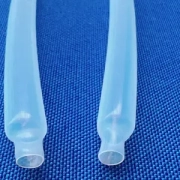
PTFE Tubing in Automotive: Boots, Gaskets & Harness
The engine bay is a bad neighborhood for any polymer: heat, fuel, oil, coolant, and vibration, all at once. The parts that survive there are the ones picked for the environment, not the catalog. PTFE earns its place in four specific jobs.
Direct answer: In automotive, PTFE tubing is used as spark-plug boots and insulator sleeves, gaskets and seals, connector and terminal sleeves, and wire-harness insulation or heat-shrink. It survives about 260 °C (500 °F) continuous, resists gasoline, diesel, oil, and coolant, has high dielectric strength, and a coefficient of friction near 0.04. PTFE (260 °C) out-rates FEP (about 200 °C) for the hottest spots; FEP is the lower-temp option.
The four automotive jobs for PTFE tubing
Spark-plug boots and insulator sleeves
The boot sits on a hot ceramic plug and carries the high-tension lead. A Teflon-impregnated boot resists sticking and cracking on the ceramic, so it pulls off clean at the next service instead of tearing.
Gaskets and seals
Oil-pan, valve-cover, fuel-system, and water-pump seals use PTFE for chemical resistance and a non-stick face that comes apart without scraping. Filled PTFE (glass or bronze) is common here for wear.
Connector and terminal sleeves
A sleeve over a terminal or splice adds insulation and abrasion protection where a bare crimp would chafe against a bracket.
Wire-harness insulation and heat-shrink
Under-hood and powertrain wiring gets a fluoropolymer sleeve for heat, fluid, and abrasion defense — especially near the exhaust and turbo.
Why PTFE survives the engine bay
| Property | PTFE | Why it matters in a car |
|---|---|---|
| Continuous service temp | ~260 °C (500 °F) | Out-rates silicone and most rubbers near the plug |
| Chemical resistance | Near-universal | Gasoline, diesel, E85, oil, brake fluid, coolant |
| Dielectric strength | High (~20–60 kV/mm) | Insulates the high-tension lead and terminals |
| Coefficient of friction | ~0.04 | Non-stick boot release; self-lubricating sleeve |
| Flammability | UL 94 V-0 (LOI >95) | Does not sustain flame |
Real under-hood numbers: the area around a spark plug runs roughly 190 °C (375 °F) at 2 inches (5 cm) from the plug, and the turbo and exhaust manifold run hotter. That is exactly where a 260 °C-rated sleeve earns its cost.
PTFE vs silicone vs rubber
Silicone is the default boot material and it is good — flexible, cheap, clear. Its ceiling is lower (around 200 °C) and it can stick and crack on the ceramic. PTFE handles more heat and releases clean. Rubber (nitrile, EPDM) is cheap and fuel-resistant but ages fast in heat and oil. The honest call: for a plug boot that must survive years of heat cycles, PTFE; for a general low-heat grommet, silicone is fine and cheaper.
Standards and specs
- ISO 6722 — road-vehicle low-voltage cable (Part 2 covers high-voltage).
- SAE J1654 / J2030 — shielded and EV cable references.
- UL 94 V-0 — flammability, PTFE qualified.
- ASTM D3294 — PTFE tubing specification.
- RoHS / REACH — environmental compliance.
- IATF 16949 — automotive quality management, a supplier-level expectation.
Mistakes that shorten an automotive PTFE part
Trusting factory split-loom in heat
The recurring failure: corrugated nylon loom turns to brittle crumbs after three summers of heat, oil, and vibration. A fluoropolymer sleeve does not crumble — it just sits there. If the harness is near the exhaust, loom is the wrong answer.
Putting PTFE where a hot spot exceeds its rating
PTFE is rated to about 260 °C continuous. Right against a glowing manifold or turbo a measured spot can exceed that; measure the spot, do not assume the bay average.
Specifying FEP for a hot lead
FEP is about 200 °C continuous. For a spark-plug or turbo-adjacent sleeve, that is short. Use PTFE there; save FEP for cooler lines.
Over-specifying and paying for nothing
PTFE costs more than silicone or loom. For a cool, dry cabin harness, it is overkill — use it where heat, fuel, or a clean release justifies it.
How to spec automotive PTFE tubing
- The job — boot, gasket, connector sleeve, or harness insulation.
- Inner diameter and wall; filled vs virgin grade (filled for wear, virgin for purity).
- Peak temperature at the actual location, not the bay average.
- Fluid exposure — fuel, oil, coolant, brake fluid.
- Compliance — UL 94 V-0, RoHS/REACH, and IATF 16949 from the supplier if required.
Frequently asked questions
What makes PTFE spark-plug boots outlast silicone?
PTFE is rated to about 260 °C (500 °F) versus silicone near 200 °C, and its non-stick surface releases from the hot ceramic without tearing at service. Silicone is cheaper and fine for cooler boots.
Is PTFE the best wire sleeve for engine-bay heat?
For leads near the exhaust, turbo, or plug, yes — it survives the heat and fuel/oil that destroys nylon loom. For a cool cabin harness it is over-spec; use it where the environment justifies the cost.
PTFE vs silicone gaskets — which seals oil better?
Both seal oil. PTFE adds chemical resistance and a non-stick face that comes apart clean; filled PTFE wears better. Silicone is more flexible and cheaper for low-heat joints.
PTFE or FEP for automotive tubing?
PTFE for the hot spots (about 260 °C); FEP for cooler lines (about 200 °C) where you may want a clear sleeve. Match the grade to the measured temperature.
How hot can automotive PTFE tubing really get?
About 260 °C (500 °F) continuous, with short peaks higher. The spark-plug area runs near 190 °C at 2 inches; manifold and turbo spots run hotter, so measure the actual location.
Are Teflon connector sleeves worth it for sensor wiring?
For sensors near heat or fluid, yes — the sleeve adds insulation and abrasion protection the bare crimp lacks. For dry, cool harnesses, a standard sealed connector is enough.