PTFE Spiral Heat-Shrink Tubing: Stripe, Temp & Shrink Ratio
Most wire bundles look identical once they are bundled. The problem starts months later, when one line needs tracing inside a panel that runs at 200 °C and sits in solvent vapor. Printed markers rub off. Paint does not survive. That is the gap spiral-stripe fluoropolymer heat shrink was built to fill.
Direct answer: PTFE spiral heat-shrink tubing is a cross-linked PTFE tube expanded after irradiation so it “remembers” a smaller diameter and recovers tightly when reheated. A contrasting-color stripe runs through the wall along its length for permanent identification. It survives continuous service near 260 °C (500 °F) and almost all chemicals, which polyolefin shrink simply cannot do. Recovery needs concentrated heat of about 327–350 °C (620–660 °F) — a standard heat gun will not recover it.
What is spiral-stripe PTFE heat-shrink tubing?
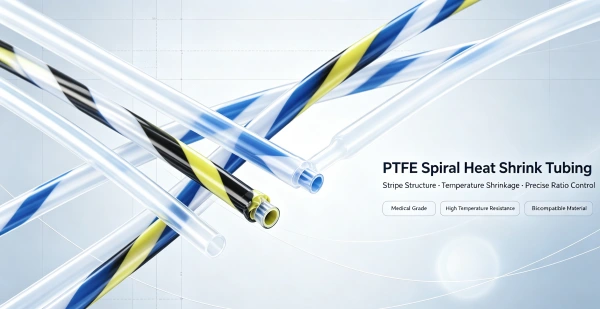
It is a fluoropolymer tube that has been irradiated and radially expanded, then cooled in the expanded state. Heat it past its recovery point and it shrinks back toward the original extruded diameter, gripping whatever sits inside. The “zebra” or spiral stripe is the part engineers care about: a band of a second color wound along the length so a specific wire, cable, or guidewire can be picked out by eye without a label.
The stripe is not a print. We extrude it as part of the wall through a striped die, so the second color is embedded in the material. That matters more than it sounds — a surface print disappears the moment the tube is recovered or abraded, while an integral stripe stays visible for the life of the part. If a customer needs a different band color or a second stripe, that is a die change, not an ink change.
How does PTFE heat shrink actually recover?
Recovery is driven by the cross-linked memory of the polymer, not by melting. Virgin PTFE does not melt cleanly, so the tube is irradiated (electron-beam or gamma) to create cross-links, expanded hot, and frozen in the larger state. Reheat it into the recovery window and the network pulls back to the set diameter.
For PTFE the recovery window sits around 327–350 °C (620–660 °F). Zeus quotes 650 °F ±50 °F (about 340 °C ±5 °C) for its military-spec PTFE shrink, and MIL-DTL-23053 Class 12 lists 350 °C ±4 °C. Either way, this is far above what a polyolefin heat gun reaches. A normal shrink gun tops out near 200 °C (390 °F) and is built for PVC/polyolefin — point it at PTFE and you get a warm tube that never recovers.
Field recovery is normally done with a concentrated hot-air tool, a heat-shrink butt or a small oven. The heat has to be even; a narrow hot spot recovers one side and leaves the other relaxed.
PTFE vs FEP heat shrink — which should you specify?
| Property | PTFE heat shrink | FEP heat shrink |
|---|---|---|
| Recovery temperature | ~327–350 °C (620–660 °F) | ~200–260 °C (390–500 °F) |
| Continuous service temp | ~260 °C (500 °F) | ~200 °C (392 °F) |
| Typical shrink ratio | 1.7:1, 2:1, up to 4:1 | Commonly 1.3:1 |
| Clarity | Opaque white | Transparent — see the wire through it |
| Spec family | MIL-DTL-23053 Class 12 | MIL-DTL-23053 Class 11 |
| Best at | High-heat, chemical, connector transitions | Lower-temp lines where you want to see through |
Pick PTFE when the environment is hot or chemically aggressive, or when you need a large shrink ratio to bridge a connector. Pick FEP when the line stays under about 200 °C and you want a clear sleeve you can inspect without removing.
What do the shrink ratios mean for your bundle?
The ratio is recovered ID to expanded ID. A 2:1 tube that recovers to 3.0 mm (0.118″) starts at about 6.0 mm (0.236″) expanded, so it slides over a 5 mm bundle and closes to 3 mm. A 4:1 ratio covers a much wider range from one size, which is why it is common at connector transitions where the body is fat and the lead is thin.
For most wire-ID jobs, 2:1 is plenty and gives the tightest recovered wall. Reach for 4:1 only when one sleeve has to bridge a large step — otherwise you recover to a wall thicker than the application needs.
Where the spiral stripe earns its place
The plain fact: in a benign office panel, a wrap of tape does the job. The stripe is for the places tape fails.
- Aerospace and defense harnesses — heat, fluid exposure, and a maintenance log that demands you trace a line fast.
- Medical guidewires and catheters — Zeus and others use a spiral stripe so a guidewire is visible against tissue; the stripe survives sterilization.
- Chemical plants and labs — solvent, acid, and steam environments where any printed marker would be gone in a week.
- High-temperature sensor leads — near engines, ovens, or process heaters.
Mistakes that turn a good spec into a field failure
Using a polyolefin heat gun
The single most common call we get: “your tube did not shrink.” It did — the gun just never reached recovery temperature. PTFE needs concentrated heat at 327 °C+; confirm the tool before you blame the material.
Specifying a shrink ratio wider than the step
A 4:1 sleeve on a 1.2:1 step recovers to a thick, loose wall that can rotate on the bundle. Match the ratio to the actual diameter step.
Asking for a printed stripe
A printed band is cheaper to set up and useless after recovery or abrasion. If the mark has to last, it has to be in the wall.
Ignoring the recovery temperature in the assembly
Some assemblies have heat-sensitive parts nearby. Plan the recovery heat so you do not cook a neighbor while you set the sleeve.
How to spec spiral PTFE heat shrink
- Expanded (over) ID and recovered (under) ID — measured over the largest and smallest part the sleeve bridges.
- Shrink ratio needed (1.7:1 / 2:1 / 4:1).
- Stripe color and count, and whether it must survive autoclave or EtO.
- Service temperature and any chemical exposure.
- Wall class — Sub-Lite-Wall down to about 0.05 mm (0.002″) where space is tight.
- Compliance: MIL-DTL-23053 Class 12, UL 94 V-0, RoHS/REACH as required.
Frequently asked questions
Will a normal heat gun shrink PTFE heat-shrink tubing?
No. PTFE recovers around 327–350 °C (620–660 °F). A standard polyolefin heat gun tops out near 200 °C and will only warm the tube. Use a concentrated hot-air tool or small oven that reaches the recovery window.
Is the stripe printed on the surface?
On a proper spiral-stripe tube, no. The stripe is extruded into the wall, so it stays visible after recovery and abrasion. A surface print wears off and should not be used where the mark must last.
What shrink ratio do I need for a wire bundle?
Match the ratio to the diameter step the sleeve bridges. For a bundle-to-connector transition, 4:1 covers a wide range; for a uniform bundle, 2:1 gives the tightest wall. Avoid a ratio far larger than the step.
Can PTFE heat shrink be used above 260 °C?
Continuous service is about 260 °C (500 °F). Short peaks toward 300 °C are tolerable for many grades; above that, confirm the specific grade and do not expect long life.
Is PTFE heat-shrink tubing medical- or food-safe?
Virgin PTFE grades are available that meet USP Class VI and FDA 21 CFR 177.1550, and the tube is sterilizable by EtO, gamma, or autoclave depending on grade. Confirm the exact lot certification with the supplier.
PTFE or FEP heat shrink for my line?
PTFE for high heat (≈260 °C) and a large shrink ratio; FEP for lower heat (≈200 °C) where you want a clear, inspectable sleeve. The stripe can be integral in both.