Medical Tie Layer Tubing for Catheter Shaft Bonding | PTFE Liner Adhesion Layer
Delamination is a major issue in catheter production, often detected too late during final inspections,
leading to product loss, field failures, and costly recalls. 为了解决这个问题, Aokeray has developed a Tie
Layer solution that strengthens the bond between the catheter jacket and inner liner, reducing the risk of
分层. This innovation enhances catheter performance, improves patient safety, and lowers
manufacturing costs, making it a comprehensive solution for catheter design and production
Medical Tie Layer Tubing for Catheter Shaft Bonding
Aokeray manufactures medical tie layer tubing for catheter shaft construction and multilayer medical tubing assemblies. The tie layer is used between materials that do not naturally bond well, such as PTFE liner and Pebax, nylon, PU or other outer jacket materials.
In catheter manufacturing, the tie layer is not a decorative layer. Its function is to improve interlayer adhesion, reduce delamination risk, and support a stable shaft structure during reflow, 层压, heat shrink processing and final device assembly.
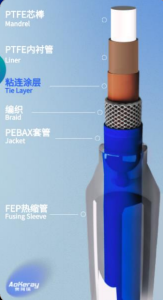
If your catheter shaft uses a 聚四氟乙烯衬里, braid or coil reinforcement, and Pebax outer jacket, the tie layer is often the key interface that determines bonding strength and shaft reliability.
CAPABILITIES
Pebax® – 25D to 55D durometers
Overall layer thickness: 0.0002”~0.0004
聚四氟乙烯衬里 .198“*0.002″
系带层- PEBAX 35D Wall: 0.0004″
FEP 热缩管 0.233″-0.155″*0.008″
夹克- PEBAX 60丁 6.1*0.21
Tolerances and performance are performed in strict accordance with QB/T 4877-2015 and ISO 10993.
What Is Tie Layer Tubing?
Tie layer tubing is a thin bonding layer used in multilayer catheter and medical tubing structures. It helps connect low-surface-energy materials, 如聚四氟乙烯, with thermoplastic outer materials that require stronger adhesion.
主要优势
- Biocompatible USP Class VI approved
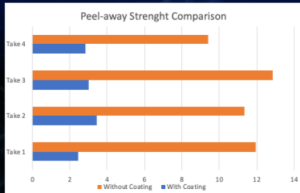
- Reduce delamination
- Improves bonding strength by 20%~30%
- Increases yield rate
- Lower manufacturing cost/scrap
- Tailored catheter performance
- Maintains overall catheter profile